Inner Transformation · The Great Work
Solve et Coagula · Dissolve and Coagulate
Jung thought that alchemy, looked at with a symbolic rather than a scientific eye, could be regarded as one of the precursors of the modern study of the unconscious — and, in particular, of analytical interest in the transformation of personality. The alchemists projected their internal processes into what they were doing, enjoying deep emotional and spiritual experiences as they carried out their various operations.
The alchemists of the fifteenth and sixteenth centuries had two interrelated aims: to transform base materials into gold, and to transform base matter into spirit — to free the soul. These goals are metaphors for psychological growth. What the psychotherapist sees in human psychology, the alchemist saw in chemical form.
Alchemy, looked at from a symbolic and not a scientific eye, can be regarded as one of the precursors of modern study of the unconscious and, in particular, of analytical interest in the transformation of personality. The alchemists projected their internal processes into what they were doing, and as they carried out their various operations, enjoyed deep, passionate emotional experiences along with spiritual ones.
Alchemy, looked at from a symbolic and not a scientific eye, can be regarded as one of the precursors of modern study of the unconscious and, in particular, of analytical interest in the transformation of personality. The alchemists projected their internal processes into what they were doing, and as they carried out their various operations, enjoyed deep, passionate emotional experiences along with spiritual ones.
Alchemy, looked at from a symbolic and not a scientific eye, can be regarded as one of the precursors of modern study of the unconscious and, in particular, of analytical interest in the transformation of personality. The alchemists projected their internal processes into what they were doing, and as they carried out their various operations, enjoyed deep, passionate emotional experiences along with spiritual ones.
Jung viewed alchemy as a system of dream and vision symbolism, helpful in explaining the archetypal roots of the modern mind. His study of alchemy started in 1920 and his book "Psychology and Alchemy" appeared in Zurich in 1944 — a magnificent exploration of the whole world of dream symbolism as related to alchemical imagery and myth.
Jung interpreted medieval Christian alchemy as a kind of dream undercurrent, flowing beneath the surface of conventional Christianity. The alchemical tradition made possible heretical speculations in secret, and could thereby release various imaginative energies of the mind. In "Psychology and Alchemy", Jung presents a theory of individuation — the maturing of the personality from its psychic roots. He was very impressed by the universal presence of mandala symbolism in differing cultures, representing the quest for harmony and balance of the human self.
Jung was in his own right a kind of prophet and alchemist of the unconscious, and his works should perhaps be seen as a part of the flow of the tradition, liberating alchemy from some of the accumulated dross.
The central image of alchemy — a commitment to ultimate value
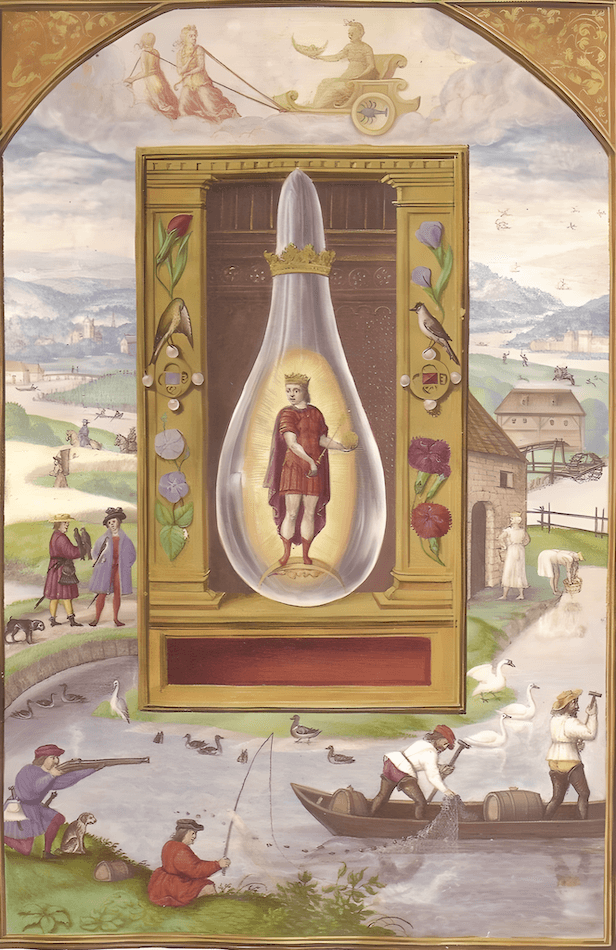
The central image of alchemy is the idea of the opus. The alchemist thought of himself as committed to a sacred work — a search for the supreme and ultimate value. Certain virtues are indispensable prerequisites. Patience is basic. Courage means a willingness to face anxiety. Continuous regimen means that through all shifts of mood and mental state one is willing to persevere in the effort to scrutinize and understand what is happening.
A careful awareness of the transpersonal level of the psyche is required — one must be Self-oriented rather than ego-oriented. There is a paradox here, as so often in alchemy and psychotherapy: the awareness of the Self and the religious attitude that such awareness brings are the goals of psychotherapy rather than requirements at the beginning. However, the potential at least must exist from the start. As one alchemist says, one must start with a bit of the Philosophers' Stone if one is to find it.
Another aspect of the opus is that it is a highly individual work. Alchemists were decidedly solitaries. They might have had one helper but no more — this refers to the uniquely individual nature of individuation. In its deepest aspects it is experienced alone. The opus cannot be performed by a committee. It thus generates a certain unavoidable alienation from the world, at least for a time.
"The basic scheme of the opus is quite simple. The purpose is to create a transcendent, miraculous substance — the Philosopher's Stone, the Elixir of Life, or the universal medicine. The procedure is, first, to find the suitable material, the prima materia, and then to subject it to a series of operations that will turn it into the Philosopher's Stone."
— E. Edinger
The original substance — and the projection it carries
The basis of the opus, the prima materia, is one of the great secrets of alchemy. This is hardly surprising, since it represents the known substance that carries the projection of the autonomous psychic content. It was of course impossible to specify such a substance, because the projection emanates from the individual and is consequently different in each case.
For one alchemist the prima materia was quicksilver; for others it was ore, iron, gold, lead, salt, sulphur, vinegar, water, air, fire, earth, blood, water of life, lapis, poison, spirit, cloud, sky, dew, shadow, sea, mother, moon, dragon, Venus, chaos, or microcosm. The endless variety of projections onto the prima materia reveals the inexhaustible richness of the unconscious — the original undifferentiated substance from which all psychic content emerges.
Prima materia — first matter, the original pure substance from which it was believed the universe was created and into which it might again be resolved. The alchemical prima materia is the receptive matter upon which the forms of all things were thought to be imprinted in the process of creation.
"The prima materia is one of the most secrets of alchemy. It represents the known substance that carries the projection of the autonomous psychic content. It was of course impossible to specify such a substance, because the projection emanates from the individual and is consequently different in each case."
— C.G. Jung
"According to the alchemists, the philosopher's stone could not be made, nor base metals transmuted into silver and gold, without their first being dissolved into the original substance or first matter."
— L. Abraham
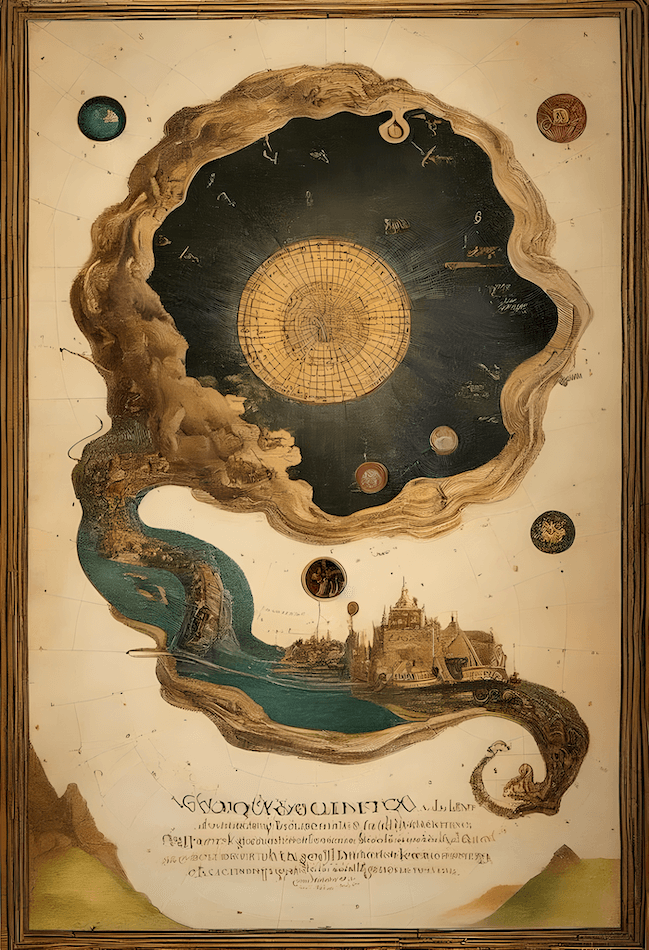
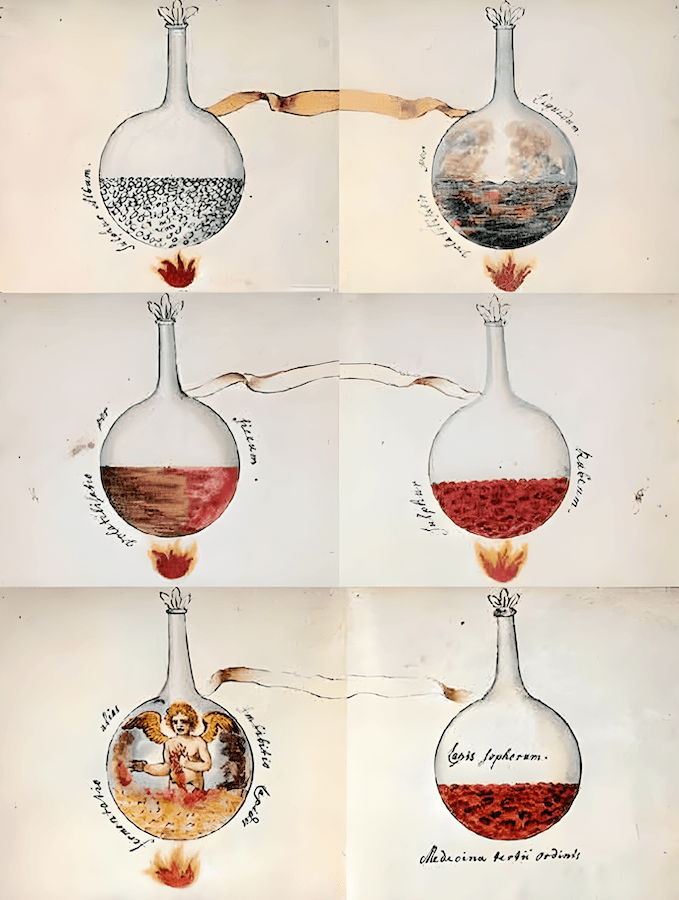
The central image of The transformative procedures of the alchemical workalchemy — a commitment to ultimate value
It is very difficult to understand alchemy as we find it in the original writings. We encounter a wild, luxuriant, tangled mass of overlapping images that is maddening to the order-seeking conscious mind. The method of ordering the chaos of alchemy is to focus on the major alchemical operations. After the prima materia has been found, it must submit to a series of chemical procedures in order to be transformed into the Philosopher's Stone.
Practically all of alchemical imagery can be ordered around these operations — and not only alchemical imagery. Many images from myth, religion, and folklore also gather around these symbolic operations, since they all come from the same source: the archetypal psyche. These central symbols of transformation make up the major content of all culture-products. They provide basic categories by which to understand the life of the psyche.
"Each of these operations is found to be the center of an elaborate symbol system. These central symbols of transformation make up the major content of all culture-products. They provide basic categories by which to understand the life of the psyche, and they illustrate almost the full range of experiences that constitute individuation."
— E. Edinger
There is no exact number of alchemical operations, and many images overlap. These seven are chosen as the major ones making up the alchemical transformation — each the center of an elaborate symbol system corresponding to a stage of psychological individuation.
Calcination · Burning
The reduction of a substance to ash by fire. Psychologically: the burning away of ego attachments, pride, and rigidity. The fire of affect and frustration that reduces inflated positions to ash, making space for new growth.
Solution · Dissolving
The dissolution of a solid into liquid. Psychologically: the return of differentiated content to an undifferentiated state — the dissolving of rigid structures, defenses, and fixed attitudes back into the unconscious flow.
Coagulation · Solidifying
The solidifying of a fluid into a stable form. Psychologically: the embodiment of an insight or psychic content into concrete reality — making real what was previously only potential or imagined.
Sublimation · Elevating
The transformation of a solid directly into vapour. Psychologically: the elevation of instinctual energy to a higher psychic level — the movement from concrete to symbolic, from literal to metaphorical understanding.
Mortification · Dying
Death, putrefaction, and blackening (nigredo). Psychologically: the experience of loss, defeat, and the death of an old identity. The dark night of the soul — necessary to any genuine transformation.
Separation · Dividing
The separation of mixed substances into their components. Psychologically: discrimination, the capacity to distinguish — separating what is one's own from what is projected, what is ego from what is Self, light from shadow.
Conjunction · Union
The union of opposites — the Sacred Marriage. Psychologically: the synthesis of previously separated aspects of the psyche into a new, unified whole. The culminating operation from which the Philosopher's Stone emerges.
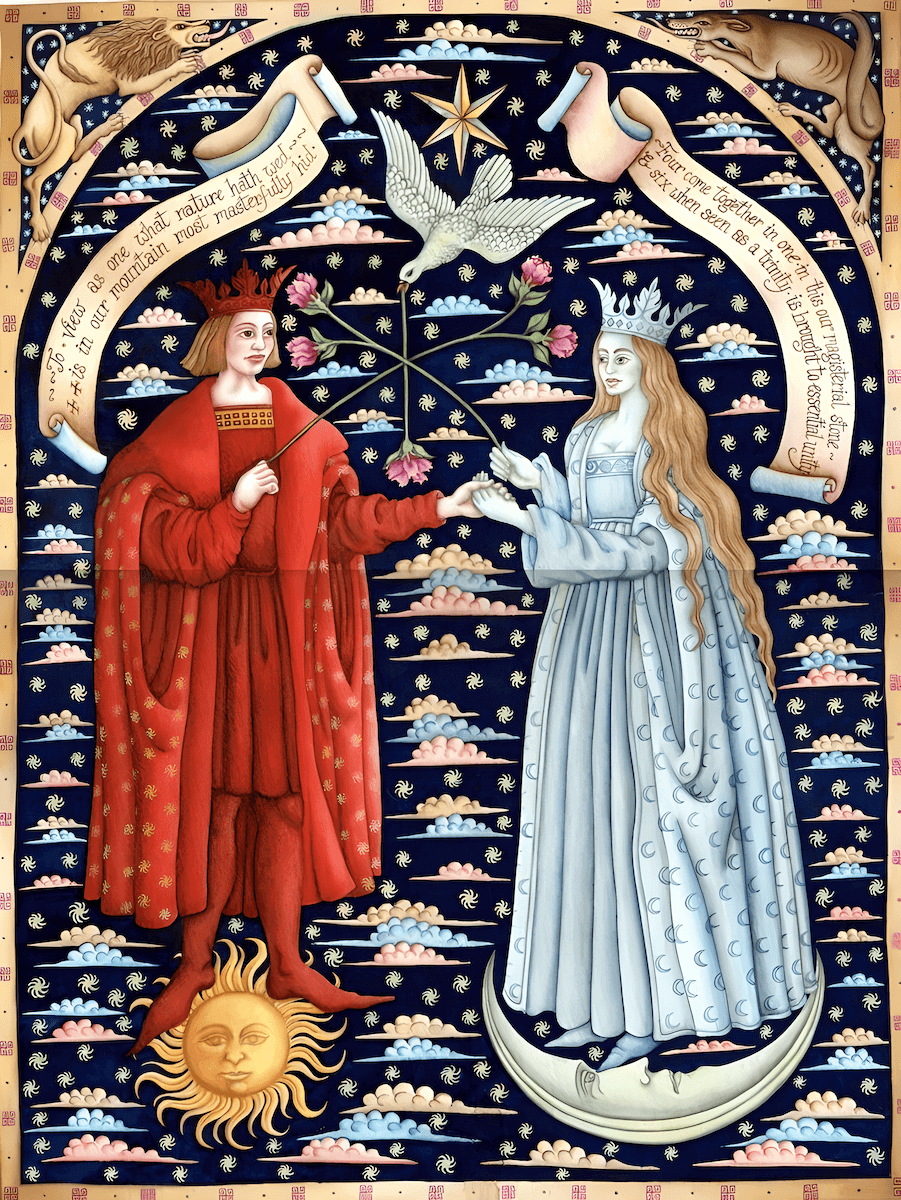
Hieros Gamos — the union of Sol and Luna
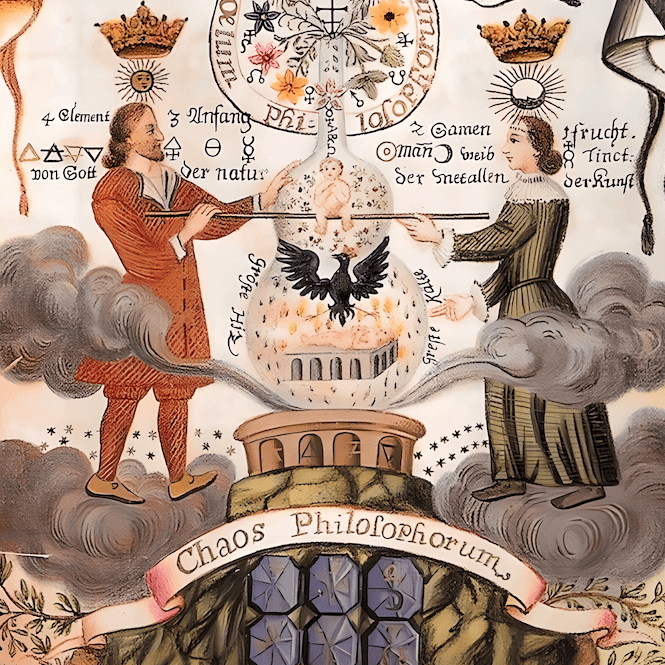
The alchemical coniunctio is the union of opposites — the supreme goal of the opus. In alchemical imagery this is often represented as a Sacred Marriage (hieros gamos) between the Sun King and the Moon Queen, between Sol and Luna, the masculine and feminine principles. Their union in the mercurial bath represents a death and a rebirth: from the dissolution of two distinct entities, something entirely new comes into being.
The two principles unite and die in the mercury bath — this is the nigredo, the blackening, the stage of dissolution that precedes all genuine transformation. Their soul abandons them, to return later and give birth to the filius philosophorum, the androgynous Rebis — the divine child who promises the imminent attainment of the Philosopher's Stone.
Psychologically, the coniunctio represents the integration of opposites within the psyche — the union of consciousness and unconscious, anima and animus, shadow and persona, thinking and feeling. It is the culminating achievement of individuation, never fully accomplished, always in process.
"Coniunctio and the ensuing death is sometimes expressed in terms of hieros gamos: the two principles — the Sun and Moon, King and Queen — unite in the mercury bath and die. Their soul abandons them to return later and give birth to the filius philosophorum, the androgynous being Rebis, which promises the imminent attainment of the Philosopher's Stone."
— M. Eliade
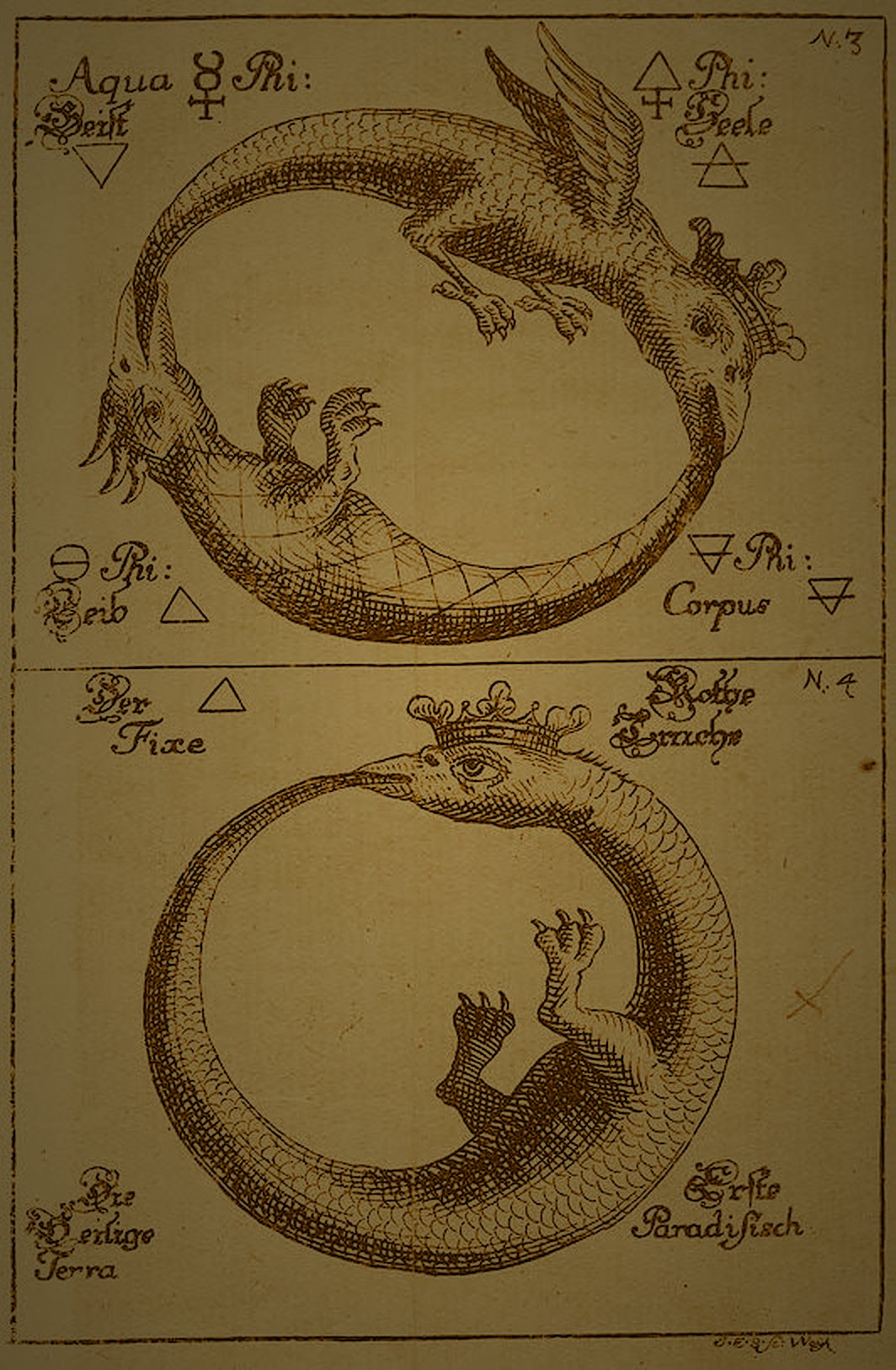
The snake devouring its own tail — symbol of the original totality
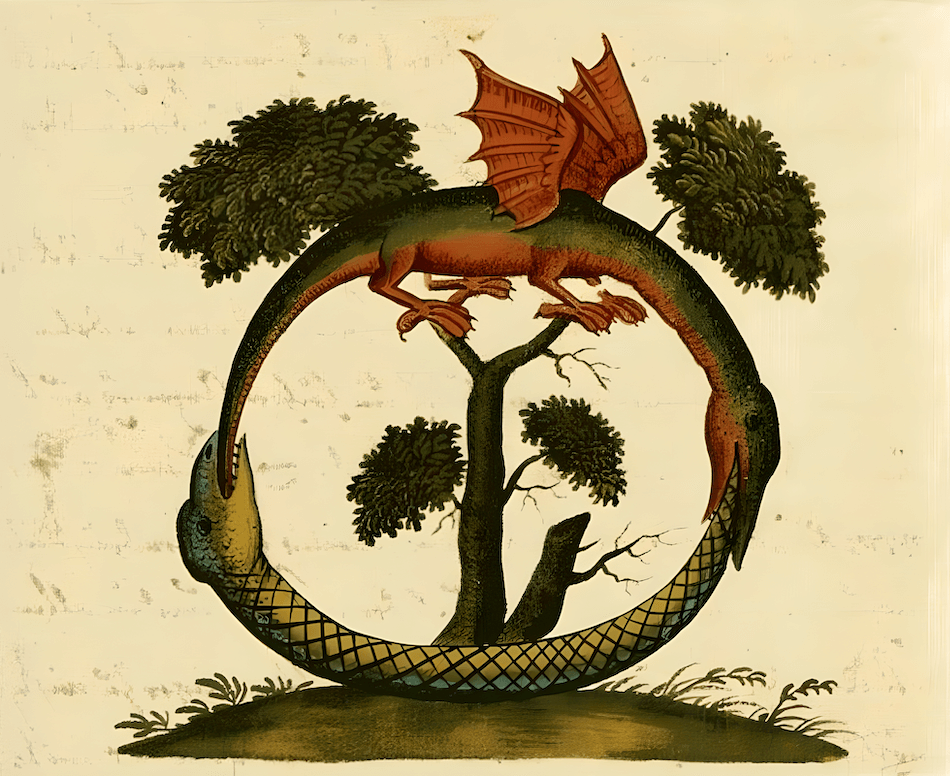
In the age-old image of the uroboros lies the thought of devouring oneself and turning oneself into a circulatory process — for it was clear to the more astute alchemists that the prima materia of the art was man himself. The uroboros is a dramatic symbol for the integration and assimilation of the opposite, that is, of the shadow.
This feedback process is at the same time a symbol of immortality, since it is said of the uroboros that he slays himself and brings himself to life, fertilizes himself and gives birth to himself. He symbolizes the One, who proceeds from the clash of opposites, and he therefore constitutes the secret of the prima materia which, as a projection, unquestionably stems from man's unconscious.
The uroboros, the circular snake biting its tail, is the symbol of the psychic state of the beginning — the original situation in which man's consciousness and ego were still small and undeveloped. As symbol of the origin and of the opposites contained in it, the uroboros is the Great Round, in which positive and negative, male and female, elements of consciousness, elements hostile to consciousness, and unconscious elements are intermingled.
"The uroboric totality also appears as a symbol of the united primordial parents from whom the figures of the Great Father and the Great Mother later crystallized out. Thus it is the most perfect example of the still undifferentiated primordial archetype."
— E. Neumann
"The uroboros is a dramatic symbol for the integration and assimilation of the opposite — of the shadow. This feedback process is at the same time a symbol of immortality, since he slays himself and brings himself to life, fertilizes himself and gives birth to himself."
— C.G. Jung
The most famous of all alchemical ideas — the perfection of imperfection
The much sought-after goal of the opus alchymicum and the most famous of all alchemical ideas. The Stone is the arcanum of all arcana, possessing the power to perfect imperfection in all things, able to transmute base metals into pure gold and transform the earthly man into an illumined philosopher. The Stone is known as the universal medicine because it can dispel all corruption, heal all disease and suffering, and bestow youth, longevity, and wisdom.
Many alchemists were aware of the fact that the Stone, or the matter for making the Stone, was to be found in man himself. Calid had stated: "This Stone is to be found at all times, in everie place, and about every man." This tradition was inherited by the medieval alchemists and the alchemists of Renaissance Europe.
Jung recognized the Stone as a projection of the unified Self — the symbol of individuation's completion. The union of opposites in the stone is possible only when the adept has become One himself. The unity of the stone is the equivalent of individuation, by which man is made one. Though the Self can become a symbolic content of consciousness, it is, as a supraordinate totality, necessarily transcendental as well.
"The union of opposites in the stone is possible only when the adept has become One himself. The unity of the stone is the equivalent of individuation, by which man is made one. We would say that the stone is a projection of the unified self."
— C.G. Jung
"The Stone is the arcanum of all arcana, possessing the power to perfect imperfection in all things. The Stone is to be found at all times, in every place, and about every man."
— L. Abraham
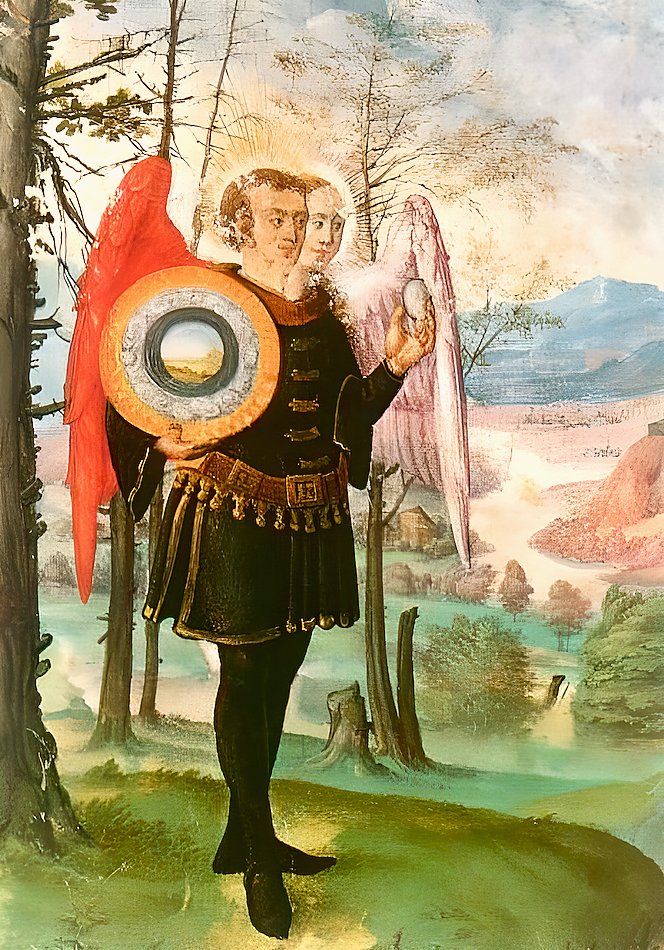
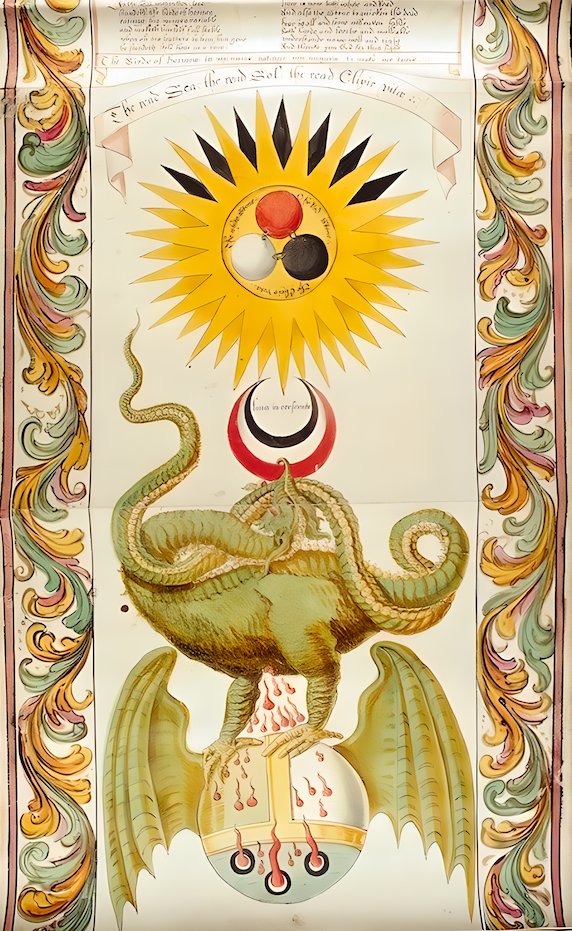
Dissolve and Coagulate — the fundamental rhythm of transformation
Alchemical evolution is epitomized in the formula Solve et Coagula — "Analyze all the elements in yourself, dissolve all that is inferior in you, even though you may break in doing so; then with the strength acquired from the preceding operation, congeal." This is the fundamental rhythm of the alchemical opus: dissolution followed by a new solidification at a higher level.
Evola writes: "Our Work is the conversion and change of one being into another being, one thing into another thing, weakness into strength, bodily into spiritual nature." The formula encapsulates the entire movement of individuation — the repeated cycle of loosening and reforming, of death and rebirth, of solutio and coagulatio — that characterizes genuine psychological growth.
The chemical putrefaction is compared to the study of the philosophers, because as the philosophers are disposed to knowledge by study, so natural things are disposed by putrefaction to solution. As by solution bodies are dissolved, so by knowledge are the doubts of the philosophers resolved. What appeared stable must be dissolved before something new can solidify. This is the essential paradox of transformation.
"Alchemical evolution is epitomized in the formula Solve et Coagula — Analyze all the elements in yourself, dissolve all that is inferior to you, even though you may break in doing so; then with the strength acquired from the preceding operation, congeal."
— J.E. Cirlot
"The chemical putrefaction is compared to the study of the philosophers, because as by solution bodies are dissolved, so by knowledge are the doubts of the philosophers resolved."
— G. Dorn
Analysis is the opus of the modern age — a sacred, individual work of transformation. Like the alchemical process, it begins not with perfection but with what is already there: the raw material of a life, with all its contradictions, its wounds, its unrealized potential.