Depth Psychology · Living Stories
Mythology is a psychology of antiquity. Psychology is a mythology of modernity. The myths that have persisted across millennia do so because they are not stories about the past — they are maps of the psyche, alive in us now, visible in our symptoms, our dreams, and the recurring shapes of our lives.
The birth of consciousness as original sin
The ancients had no psychology, properly speaking, but they had myths — speculative tellings about humans in relation with more-than-human forces and images. We moderns have no mythology, properly speaking, but we have psychological systems: speculative theories about humans in relation with more-than-human forces and images, today called fields, instincts, drives, complexes.
Myth lives vividly in our symptoms and fantasies and in our conceptual systems. Archetypal psychology — perhaps its hallmark distinguishing it from other psychologies — offers the opportunity to reflect every psychological position as a fantasy or mythologem. It works as a self-critique of positivisms by means of myths.
The aim is to reflect back and forth between the two, myth and psyche, using them to provide insights for each other — preventing either from being taken on its own terms only. A myth tells us something about the structure of the inner world. And the inner world casts light back onto the myth, showing us what it has always been about.
"There is a barrier or threshold between Conscious and Unconscious. The myths describe the hazards of getting across. There is trading and bargaining for what you want — and something invariably has to be given, preferably something precious to the Ego."
— T. Chetwynd
"Myth lives vividly in our symptoms and fantasies and in our conceptual systems. Mythology is a psychology of antiquity. Psychology is a mythology of modernity… We seek to reflect back and forth between the two, myth and psyche, using them to provide insights for each other, preventing either from being taken on its own terms only."
— James HIllman
"Our tenet also operates upon every mythic tale and figure, removing them from the realm of story only and pulling them down and in — showing how a myth precisely works in the psyche, in its habits of mind and heart."
— James HIllman
The birth of consciousness as original sin
The Garden of Eden is comparable to the Greek myth of the golden age and Plato's original round man. The Garden has certain features of a mandala — with four rivers flowing from it and the tree of life at its center. The mandala-garden is an image of the Self, representing the ego's original oneness with nature and deity.
The drama of temptation and fall begins when the original state of passive inflation turns into the active inflation of a specific deed. The serpent's whole approach and appeal is expressed in inflationary terms — "if you eat of this fruit, your eyes will be opened and you will be like God." It all begins because Adam and Eve dare to act on their desire to be like God.
The myth depicts the birth of consciousness as a crime which alienates man from God and from his original preconscious wholeness. The fruit is symbolical of consciousness: it is the fruit of the tree of the knowledge of good and evil, which means it brings awareness of the opposites — the specific feature of consciousness. Consciousness, according to this myth, is the original sin, the original hybris, and the root cause of the fall.
"Eating the forbidden fruit marks the transition from the eternal state of unconscious oneness with the Self — the mindless, animal state — to a real, conscious life in space and time. In short, the myth symbolizes the birth of the ego."
— E. Edinger
The ego overcomes the devouring unconscious
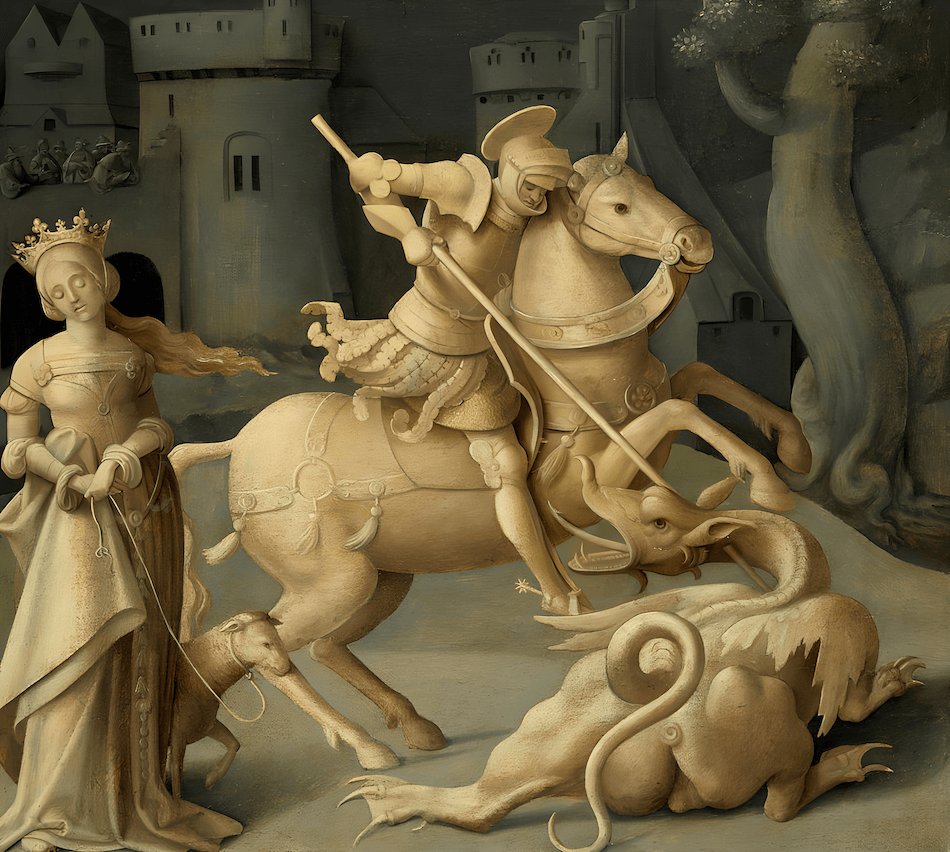
In myths of creation, dragons are usually violent primeval creatures who must be defeated by the gods. Later, heroes and ancestors of noble lines take on the role of dragon-slayers — the intellectually superior human overcoming the untamed natural world. In fairy-tales and legends, slaying the dragon is a frequent test of the hero's mettle; if he succeeds, he will obtain a treasure or free a captive princess.
The dragon is a symbol of the bestial element which must be defeated with strength and discipline. In Christian symbology the dragon embodies the diabolical element — the satanic Lucifer, whom the archangel Michael defeated and plunged into the pit of hell. Dragons are therefore often associated with fire, portraying that primeval chaos which was to be destroyed only through disciplined marshaling of mental and physical prowess.
Apollo, Cadmus, Perseus and Siegfried all conquer the dragon. In numerous masterpieces of hagiography, the patron saints of knighthood — St. George and St. Michael the Archangel — are depicted in the very act of slaying the monster. The dragon appears with the meaning of the primordial enemy with whom combat is the supreme test.
"If we examine the myth of the hero psychologically, we can see how in the successive phases a transformation takes place in the relationship between the masculine ego and the feminine element — from an ego originally contained in feminine protectiveness, through violent opposition to the 'terrible mother,' culminating in the slaying of the dragon."
— A. Carotenuto
"In a great many legends, overlaying its deepest symbolic sense, the dragon appears with this very meaning of the primordial enemy with whom combat is the supreme test."
— J.E. Cirlot
Flight, hubris, and the meteoric fall of the ego
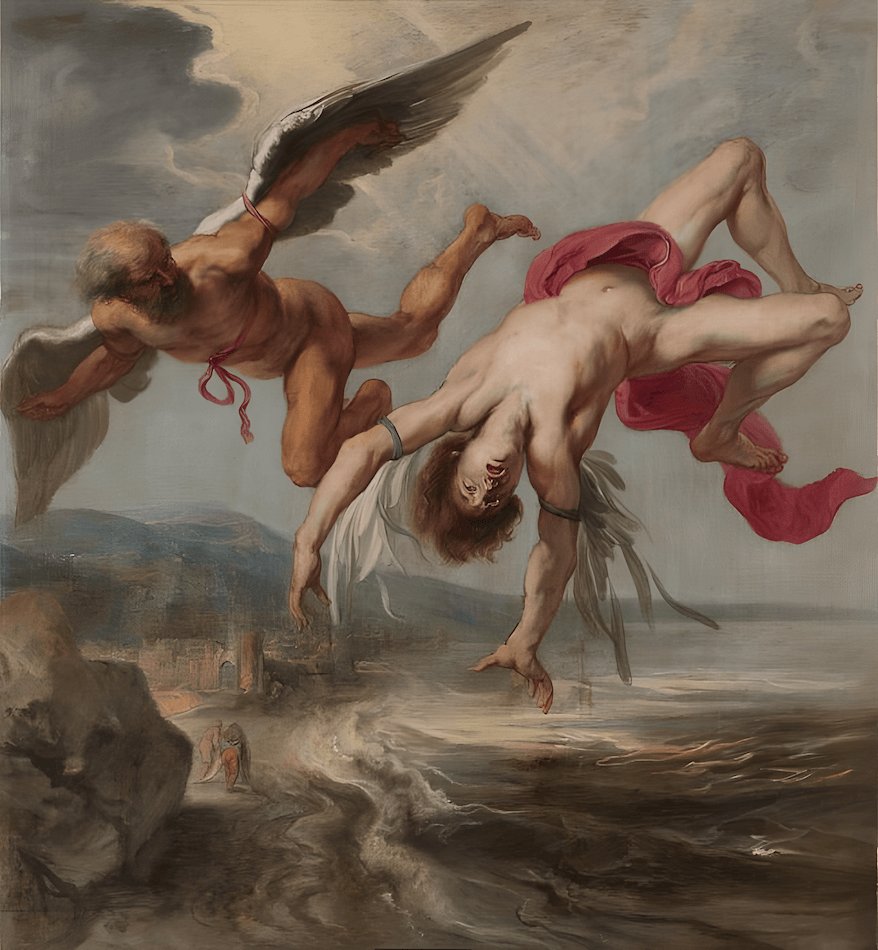
Symbolically, Icarus describes man's life — the years that fly — as skimming between sun and sea: that is, between the male conscious ego and feminine unconscious emotion. Icarus is given wings of wax and feathers made by his father Daedalus, who warns him not to fly too high, or the sun will melt the wax, and not too low, or the feathers will get wet in the sea.
Superficially, it is a moral tale which ends badly when the boy disobeys his father. Symbolically, the story has associations with the flight into the mind realm, ignoring material factors — and with total identification with the conscious ego. Icarus is in a state of elation as he flies up. The ego has only a short reign. The story reflects the typical pattern of the meteoric rise and fall of the ego in life.
Icarus is the mythical creature who symbolizes the human wish to soar through the clouds like a bird, to float in a state of weightlessness — but his story also constitutes a warning against arrogance. Unlike Daedalus, who represents astute intellect, Icarus is intellect blinded by vanity; he will not heed his father's advice. Dreams of flying are interpreted generally as expressing the desire to be freed from the restraints of gravity — from the world in which we live.
"Since the sun is a symbol of the spirit, flight towards the sun symbolizes spiritualization. But flight upon wings of wax can only denote a senseless form of spiritualization — vain exaltation. The intellect (father) has become perverted imagination (son)."
— P. Diel
"Artificial wings symbolize perverse imagination — the antithesis of sublime imagination. They signify flight that remains earthbound, the diabolical seduction of exalted desires that degenerate into daydreaming."
— P. Diel
The conflict between soul and love — between darkness and the need to see
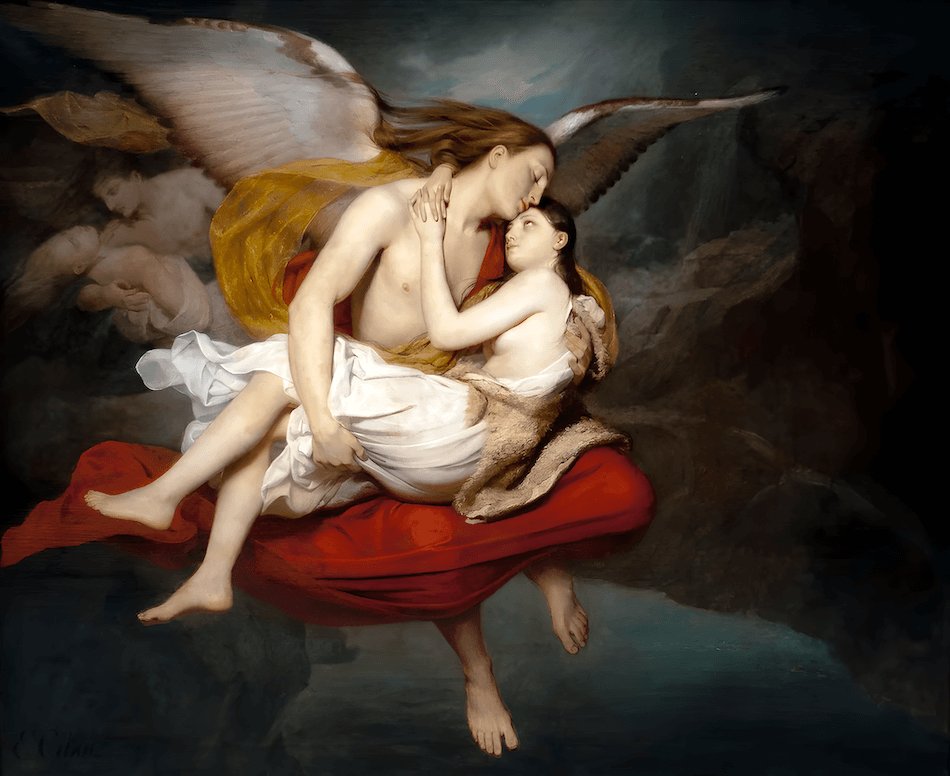
The famous mythical drama of Psyche and Eros is an illustration of the conflict between soul and love. Although the maiden Psyche surpassed all others in beauty, she could not find a husband, since her very loveliness set up a barrier. Her parents consulted the oracle and were told to dress her in bridal clothes, lead her to a mountain, and leave her on a cliff-top, where a monster would come to take her for its bride.
In a magnificent palace, voices served her like slaves. That night she felt a presence at her side but did not know who it was — her husband had warned her that if she ever saw him she would lose him forever. Her jealous sisters awoke her misgivings, and by lamplight she found a handsome youth sleeping at her side. A drop of hot oil fell upon Eros. Thus Love was revealed and fled away. Now Psyche's misfortunes began: Aphrodite set ever more difficult tasks as punishment. Yet Eros could no more forget Psyche than she him. He obtained permission from Zeus to marry her; Psyche became his wife and was reconciled to Aphrodite.
In this myth Eros symbolizes love and the longing for physical satisfaction, while Psyche personifies the soul tempted to experience this love. Darkness and the agreement not to look at the lover denote the resignation of spirit and consciousness to overweening longing — a blind surrender to the unknown. Consciousness still slumbers; the sisters' questions are merely doubts and curiosity aroused once the senses have been sated.
"With love thus deified, Psyche and Aphrodite — two aspects of the soul, desire and consciousness — are reconciled. Eros no longer appears as a solely physical presence and is no longer dreaded as a monster: love is integrated into life."
— J. Chevalier & A. Gheerbrant
"The Soul experiences even the abyss of Hell where Persephone gives her a flask containing the water of youth — the principle of renewal after expiation. Psyche falls asleep and is awakened by an arrow shot by Eros, who has been searching desperately for her everywhere — this represents the survival in her of desire."
— J. Chevalier & A. Gheerbrant
Analysis is a way of learning to read it — the recurring figures, the threshold moments, the dragons that must be faced. These are not abstractions. They are living forces in the psyche, visible in dreams, in symptoms, in the shape of a life.