Founder of Analytical Psychology
26 July 1875 — 6 June 1961
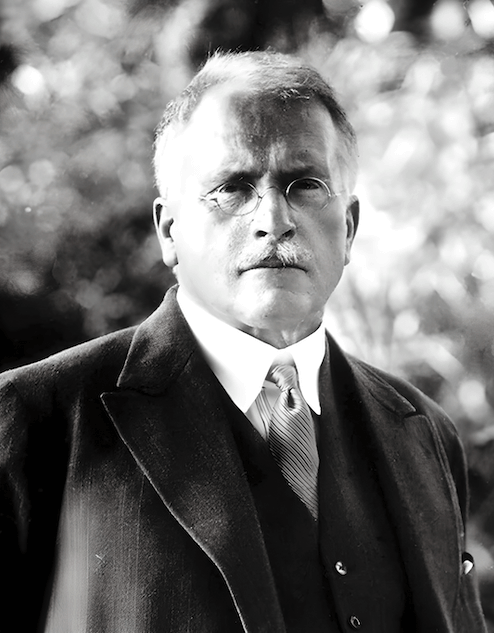
Swiss psychiatrist, psychoanalyst, and founder of analytical psychology — the first thinker to map the deeper architecture of the unconscious mind: the collective unconscious, the archetypes, the process of individuation, and the psyche's innate movement toward wholeness.
1875 – 1961
Kesswil, Switzerland · Küsnacht, Switzerland
Carl Gustav Jung was born on 26 July 1875 in Kesswil, a small village on Lake Constance in Switzerland, the son of a Protestant minister. From early childhood he was drawn to questions that lay beyond the reach of conventional religion — questions about the nature of the psyche, the meaning of dreams, and the hidden forces that shape human behaviour. He described himself as having two personalities: one an ordinary schoolboy, the other an ancient figure who lived in another century.
After studying medicine at the University of Basel, he trained under Eugen Bleuler at the celebrated Burghölzli psychiatric clinic in Zürich — one of the foremost centres of psychiatric research in the world. Here he developed the word association test, which demonstrated the existence of unconscious emotional complexes long before analysis had a theoretical vocabulary for them.After studying medicine at the University of Basel, he trained
In 1907 he met Sigmund Freud, and for several years the two men maintained an extraordinarily productive intellectual partnership. Freud regarded Jung as his chosen heir, his "crown prince." But the relationship broke — definitively, painfully — in 1913, when Jung's theoretical divergences from Freudian orthodoxy made separation inevitable. Jung's view of the unconscious was fundamentally different: richer, more expansive, rooted not only in personal history but in the collective inheritance of the human species.
The years following the split with Freud were a period of profound psychological crisis — what Jung later called his "confrontation with the unconscious." He withdrew from the academic world, descended deliberately into the depths of his own psyche, and recorded his visions, dreams, and fantasies in what would eventually become the Red Book. This period of self-analysis, lasting roughly from 1913 to 1920, was the crucible in which virtually all of his mature ideas were formed.
From this experience emerged the great concepts that would define his life's work: the collective unconscious and its archetypes, the psychological types, the process of individuation, the shadow, the anima and animus, the Self as the centre and totality of the personality. He traveled widely — to North Africa, to the American Southwest, to Kenya and Uganda, to India — gathering evidence for the universality of psychic structures across cultures and centuries.
He founded the C.G. Jung Institute in Zürich in 1948, which became the training ground for analysts from around the world. He continued writing and lecturing well into old age, completing his late masterwork Mysterium Coniunctionis in his eightieth year. He died at his home in Küsnacht on 6 June 1961, aged 85.
"A fantasy needs to be understood both causally and purposively. Causally interpreted, it seems like a symptom of a physiological state. Purposively interpreted, it seems like a symbol, seeking to characterize a definite goal — or trace out a line of future psychological development."
— C.G. Jung
Carl Gustav Jung born 26 July in Kesswil, Canton Thurgau, to Paul Achilles Jung, a Protestant minister, and Emilie Preiswerk. The family moves to Klein-Hüningen, near Basel, when Jung is four years old.
Studies medicine at Basel, becomes deeply interested in psychiatry after reading Krafft-Ebing's textbook. Graduates in 1900. His doctoral dissertation draws on séances with his cousin Hélène Preiswerk — an early indication of his lifelong interest in occult phenomena and the unconscious.
Joins Eugen Bleuler's Burghölzli clinic in Zürich. Develops the word association test, demonstrating the existence of emotionally charged unconscious complexes. Marries Emma Rauschenbach in 1903. Publishes The Psychology of Dementia Praecox (1907).
Following the break with Freud, Jung enters a period of intentional immersion in his own unconscious — recording dreams, visions, and active imagination in the Liber Novus (Red Book). This crucible period gives rise to virtually all of his mature theoretical concepts. He resigns from the University of Zürich in 1914.
Following the break with Freud, Jung enters a period of intentional immersion in his own unconscious — recording dreams, visions, and active imagination in the Liber Novus (Red Book). This crucible period gives rise to virtually all of his mature theoretical concepts. He resigns from the University of Zürich in 1914.
His first major post-Freudian theoretical work introduces the concepts of introversion and extraversion, and the four psychological functions (thinking, feeling, sensation, intuition). These typological distinctions entered everyday language and became the basis for numerous personality assessment systems.
Extensive travels to gather cross-cultural evidence for universal psychic structures. Visits North Africa (1920), the Pueblo peoples of New Mexico (1924–25), Kenya and Uganda (1925–26), and India (1937–38). Builds his tower at Bollingen on Lake Zürich — a stone retreat he constructs himself over decades.
Publishes his major study of alchemy as a symbolic system mirroring the individuation process. The same year he suffers a severe heart attack and records a series of visions during his near-death experience — visions he later describes in Memories, Dreams, Reflections.
Establishes the institute that bears his name, providing formal training for Jungian analysts worldwide. The institute remains a major centre for analytical psychology and continues to train analysts to the present day.
Following the break with Freud, Jung enters a period of intentional immersion in his own unconscious — recording dreams, visions, and active imagination in the Liber Novus (Red Book). This crucible period gives rise to virtually all of his mature theoretical concepts. He resigns from the University of Zürich in 1914.
Jung was a prodigious writer. His Collected Works run to twenty volumes. These six titles represent the essential core of his contribution.
Psychologische Typen
Introduces the introversion/extraversion distinction and the four functions of consciousness — thinking, feeling, sensation, and intuition. The most widely read of Jung's theoretical works, and the source of the MBTI typology. Establishes Jung's independence from Freudian metapsychology.
Psychologie und Alchemie
A monumental study of medieval alchemy as a symbolic system anticipating and paralleling the modern discovery of the unconscious. Demonstrates through a patient's dream series that alchemical imagery arises spontaneously from the individuation process. With "Mysterium Coniunctionis", represents Jung's most sustained scholarly achievement.
Collected Works, Vol. 9i
The foundational exposition of the collective unconscious and its archetypal contents. Contains the essential essays on the shadow, the anima, the animus, the mother archetype, the child archetype, and the concept of individuation as a psychological and spiritual process.
Antwort auf Hiob
Jung's most personally confessional work — a sustained psychological and theological reflection on the Book of Job, the problem of evil, and the nature of God. Written at speed following his near-death experience and widely considered his most provocative and original late work.
Mysterium Coniunctionis
Jung's final great work, completed in his eightieth year. A deep investigation into the alchemical symbolism of the union of opposites — the coniunctio — as the symbolic representation of the completed individuation process. The culmination of his forty-year engagement with alchemy.
Erinnerungen, Träume, Gedanken
Dictated in Jung's final years to his secretary Aniela Jaffé, this is the closest thing to a autobiography he produced. An extraordinary account of his inner life — his childhood visions, the break with Freud, the confrontation with the unconscious, his travels, and his thoughts on death and the life of the soul.
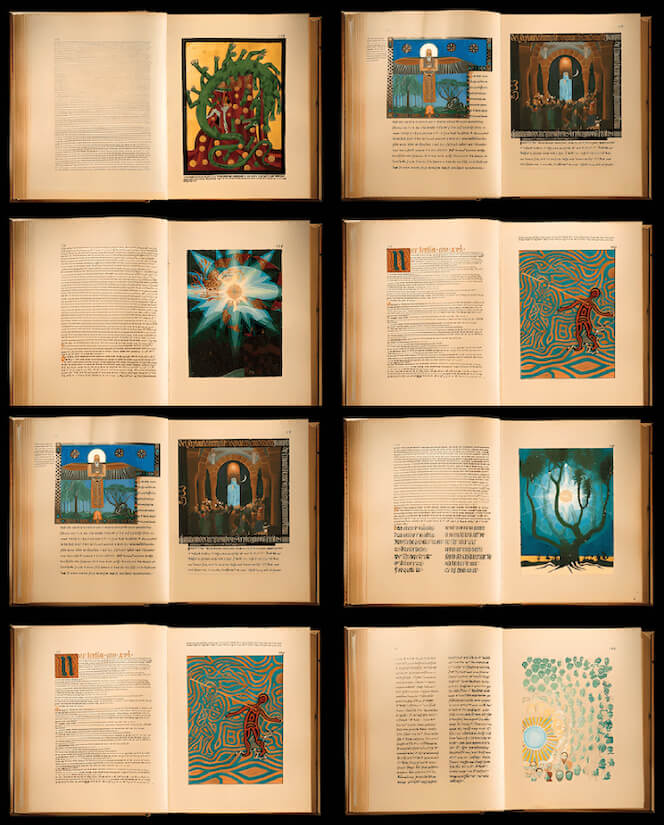
Jung's deliberate descent into the unconscious — and the origin of every idea that followed.
Between 1913 and roughly 1930, Jung recorded his encounters with the unconscious in a large folio volume — hand-lettered in calligraphic script, illustrated with his own paintings and mandalas, saturated with visionary imagery. He called it the Liber Novus: the New Book. After his death it remained locked in a bank vault in Zürich, shown to only a handful of people, for nearly half a century.
When it was finally published in 2009, it emerged as one of the most extraordinary documents in the history of psychology — a record of a deliberate descent into the unconscious that reads simultaneously as a spiritual autobiography, a mythological epic, and a clinical case study of the man who invented the field of depth psychology. The Red Book contains, in inchoate and visionary form, virtually every concept that Jung would later develop systematically.
The central experience of the Red Book is Jung's encounter with a series of inner figures — Elijah, who transforms into Philemon; Salome; the spirit Izdubar; a series of serpents and gods. These figures are not fantasies in the ordinary sense. Jung understood them as autonomous psychic contents, real in their own domain, with whom dialogue was possible and necessary. The technique he developed from this experience — active imagination — became one of the hallmarks of Jungian practice.
"The years when I was pursuing my inner images were the most important in my life — in them everything essential was decided. It all began then; the later details are only supplements and clarifications of the material that burst forth from the unconscious."
— C.G. Jung, on the Red Book period
Jung's contribution to psychology extended far beyond the consulting room. These six concepts form the core of his theoretical legacy — and the conceptual foundation of the clinical work practiced here.
Beneath the personal unconscious — the layer of forgotten and repressed personal experience — lies a deeper stratum shared by all humanity: the collective unconscious. Its contents are the archetypes: universal patterns and images that appear across cultures, centuries, and dreams.
The central teleological concept in Jung's psychology — the lifelong process of becoming who one most deeply is. Individuation is not self-improvement or adaptation; it is the differentiation of the personality toward its unique wholeness, including its shadow and its contradictions.
For Jung, dreams are not disguised wish-fulfilments (as Freud held) but authentic expressions of the unconscious — compensatory messages from the deeper psyche to consciousness. They speak in images, in symbols, and occasionally in what Jung called the "big dream": the numinous vision that reorients a life.
Mythology is not primitive error but the oldest form of depth psychology — the projection of inner psychic structures onto the outer world. The myths that have survived across millennia survive because they map something real about the structure of the human psyche
Jung's most unexpected and most profound contribution: the demonstration that medieval alchemy was not failed chemistry but a sophisticated symbolic system mapping the transformation of the psyche. The alchemist's work — dissolving, purifying, and recombining base matter — is a metaphor for the inner work of analysis.
Introduced formally in 1952 in collaboration with physicist Wolfgang Pauli, synchronicity names the phenomenon of meaningful coincidence — two events connected not by cause but by meaning. Jung regarded it as evidence that psyche and matter share a common underlying substrate, and that the unconscious can interact with external events.
"Your vision will become clear only when you look into your own heart. Who looks outside, dreams; who looks inside, awakes. The most terrifying thing is to accept oneself completely."
— C.G. Jung · Letter to Fanny Bowditch Katz, 1928
The concepts Jung developed are not merely intellectual constructs — they are living realities encountered in the course of analysis. Dreams, archetypes, individuation: these are experiences before they are ideas. The consulting room is where the theory becomes personal.