Jungian Essays
On the structural relationship between the organizing center of consciousness and the totality of the psyche — and what the tension between them means for a life.
There is a larger organizing intelligence that precedes the ego, exceeds it, and quietly orders it. Drawing on Jung, Edinger, Neumann, and Samuels, this essay traces the structural relationship between the ego and the Self, the axis that connects them, and the three states every psyche moves through: the original inflation of unconscious wholeness, the alienation that follows its collapse, and the conscious dialectic we call individuation.
Most people move through the world with the quiet assumption that they are the authors of their own experience: that the “I” who thinks, decides, plans, and acts is the whole of who they are. This is not a delusion, exactly — the ego is real, and it does all of those things — but it is, in the Jungian view, a profound and consequential incompleteness.
The ego is the center of conscious life, the seat of subjective identity, the organizing structure that carries memory forward through time and intention forward into action. Edinger describes it as “the elaborate receptive organ for assessing reality (whether conscious or unconscious).” Without a functioning ego, there is no coherent person, no navigable inner life, no capacity to inhabit one’s own experience with continuity or direction. Analysis does not seek to dissolve the ego, as it depends on one.
And yet the ego is full of what Chetwynd calls “delusions and limitations” — a fact it characteristically cannot see, because the very structure that would need to perceive its own limits is the structure that has constructed them. This is not a moral failing, but it reflects the ego’s functioning in its early phases: to mistake that partial knowing for the whole.
The part of ourselves that the ego cannot see or admit to is the Shadow. It represents the sum of everything that has been excluded from conscious identity, split off, repressed, or simply never developed. And it is precisely this ignorance of one’s own limitations and the refusal to encounter the Shadow that most commonly ruptures what analytical psychology calls the ego-Self axis. An ego that refuses to recognize what lies beyond its limits loses its living connection to the full reality of who it is. In Edinger’s terms, it becomes identified with the Self rather than related to it — and the effects of this identification shape every stage of psychological development.
But to understand what that identification means, we must first be precise about what the Self is.
In Jungian psychology, a distinction that is difficult to hold at first but becomes impossible to relinquish once grasped: the ego is the center of consciousness, while the Self is the center of something far larger. As Jung wrote:
"The self is not only the centre, but also the whole circumference which embraces both conscious and unconscious; it is the centre of this totality, just as the ego is the centre of consciousness."
Using a sacred geometry analogy, the Self is simultaneously the center point and the circumference that contains everything. The Self, in Edinger's formulation, is "the ordering and unifying center of the total psyche — conscious and unconscious together." It would be wrong to imagine the Self as a larger ego, or as the ego's superior or adversary. The Self is the psychic ground from which the ego emerged, and to which it remains connected even when that connection is damaged or obscured.
From a phenomenological standpoint, Edinger calls the Self "the supreme psychic authority," and describes it as the "inner empirical deity, identical with the imago Dei" In that framework, the Self functions the way God functions in religious experience: as the organizing principle that subordinates everything else to its own purposes, as the source from which meaning flows, and as the power before which the ego must eventually learn to orient itself without disappearing into it.
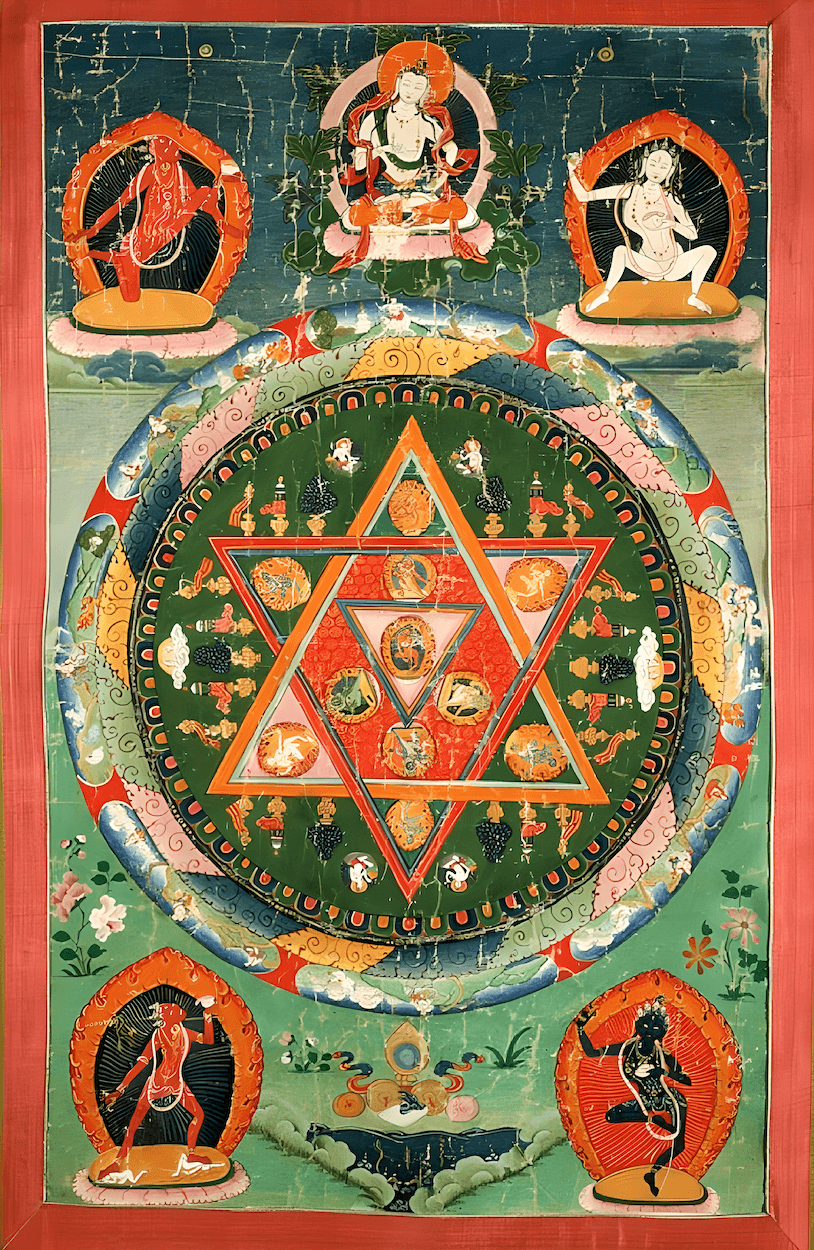
The widespread images of the Self across all human cultures confirm this. One of them is the mandala, which represents a circle with a center, enclosing a fourfold symmetry. Hall describes the Self as "the central archetype of order," and the mandala is its symbolic body: a containing structure that is also an ordering one, holding chaos within a form without destroying it. Edinger observes that mandala images arise spontaneously in children at moments of psychic crisis, as though the psyche reaches for its own symbol of wholeness when the ego is threatened. The same images appear in the dreams, thus the Self declares its presence.
Andrew Samuels is precise on what this presence means for the life of the individual:
"The Self as a unifying principle within the human psyche occupies the central position of authority in relation to psychological life and, therefore, the destiny of the individual."
It is the recognition that the Self has its own functions, orientation, and claims on a person's existence. We often resist these claims, but, ultimately, we cannot override them without significant psychological cost.

LP · NCPsyA · SCPsyA
Jungian psychoanalyst practicing in New York's West Village. This journal presents original essays on depth psychology, dreams, and the inner life.
-S.png)
Since there are two autonomous centers of psychic being — the ego as center of consciousness, the Self as center of the totality — the relation between them becomes, as Edinger writes, "vitally important." He calls this relation the ego-Self axis: the fundamental relationship between the conscious personality and the archetypal depths from which it emerged.
Neumann understood the Self as establishing "a 'derivative' of itself, an 'authority,' the ego, whose role it is to represent the interests of the totality over against the particular demands of the inner world and the environment." The ego is not the Self's creation in a simple hierarchical sense; it is more like the Self's representative in consciousness, and its organ of contact with reality. This is why Edinger, drawing on Jung, said that "the ego stands to the Self as the moved to the mover." His formulation distinctly echoes Aristotle's "unmoved mover," and what Cirlot found its most poignant expression in Dante's closing image of The Divine Comedy: "L'amor che move il sole e l'altre stelle," or "The love that moves the sun and theother stars."
The interdependence represents an important characteristic of this relationship and can be easily missed if looked at through a simplified lens. The Self needs the ego: without a functioning ego, the contents of the archetypal psyche cannot enter consciousness; they remain potential, inert, unwitnessed. The Self's purposes cannot be realized in the world without the ego as their vehicle. And equally, the ego cannot sustain itself without the Self. Edinger is explicit: "Clinical observation leads one to the conclusion that the integrity and stability of the ego depend in all stages of development on a living connection with the Self." The Self "stands behind the ego and can act as a guarantor of its integrity."
When this axis is relatively intact, there is a particular quality to a person's inner life: the capacity to be genuinely moved. This openness to all emotional experience, including the difficult and the unwelcome, is what livens the ego-Self Axis. The ego that is well-rooted in the Self does not need to defend itself from its own depths. It can afford to be porous.
In that respect, dreams become "the expressions of the ego-Self axis," as Edinger puts it. We may experience them as mere noise generated by a sleeping brain, but they are meaningful messages from the center of deep wisdom that does not sleep. Whether the ego has the receptivity to receive those communications is a different question entirely.
We are all born in a state of inflation. Let us look at what it actually implies.
In the earliest infancy, no ego exists. There is only the Self, or more precisely, the primordial totality out of which the ego will eventually emerge. The infant cannot yet distinguish inner from outer, self from world. Everything is continuous, undifferentiated, and whole. Neumann named this original state the uroboros, the ancient image of the serpent swallowing its own tail: a circle closed upon itself, representing the psyche before it has become two.
The latent ego, not yet born into separateness, rests in complete identity with the Self. It experiences itself, retrospectively and without language, as something like deity: boundless, total, unopposed. Edinger calls this "the original state of unconscious wholeness which is responsible for the nostalgia we all have toward our origins, both personal and historical." The paradise myths of every culture are expressions of this original condition. Plato's account of the original round man, Hesiod's golden age, Wordsworth's "trailing clouds of glory" — they are all, in Edinger's reading, phenomenological reports on the same psychological reality: the ego in its first and foundational state of identity with the Self.
This original state leaves a deep imprint in every adult psyche. Beneath the structures of identity, below the carefully assembled personality, there persists a residue of that primal wholeness, a longing for a completeness that once was seamlessly inhabited and has never been entirely relinquished. In that sense, inflation is not pathological, but structurally informed.
When inflation, however, persists past its developmental moment, it becomes something else. The ego begins to claim, consciously or unconsciously, what belongs to the Self alone: omniscience, ultimate authority, exemption from the leveling conditions of ordinary human existence. Grandiosity is its obvious face, but the subtler forms are harder to name or to treat. The certainty of possessing a universal truth. The conviction that one's suffering is of a uniquely irretrievable depth. The power motivation that operates just beneath the surface of apparently generous action. The animus pronouncement that mistakes itself for revealed wisdom. Edinger is precise:
"Power motivation of all kinds is symptomatic of inflation. Whenever one operates out of a power motive, omnipotence is implied."
And this is where myths wisely illuminate the dark side of this structure: inflation always ends in a fall.
The myths are unequivocal on this point: inflation ends in a fall. It is a structural inevitability. The ego that has identified with the Self cannot sustain that identification against the actual conditions of existence. Reality frustrates the inflated expectation. The world does not bend to the will of the one who has unconsciously assumed it would.
Icarus flew too close to the sun, and his wax wings melted. Phaeton seized the sun chariot and plunged to earth in flaming ruin. Adam and Eve ate the forbidden fruit and were cast out of Eden. Prometheus stole the fire from the gods and was bound in eternal punishment. The arc of these myths is identical because they all describe the same psychological event: the ego's inevitable collision with the limits it refuses to acknowledge, and the rupture that follows.
Edinger notes that this collision damages the ego-Self axis. What follows is alienation: not merely sadness or disappointment, but a distinct psychological condition in which the ego has been cut off from its grounding in the Self. It has been exiled from the source of meaning and vitality. Here the biblical imagery is apt: this is the expulsion from the garden. Something once seamless has been torn.
This is the state Edinger documents with clinical and literary precision. Leo Tolstoy, at fifty—successful by every external measure—suddenly unable to locate any reason to live: "I felt that something had broken within me on which my life had always rested." Dante at the midpoint of life's journey, finding himself in a dark wood, the right path lost. Goethe's Faust, cooped up among his books, suffocated by his own learning. Melville's Ishmael, who opens Moby Dick by choosing the sea over "pistol and ball", the voyage as his substitute for self-destruction. T.S. Eliot's wasteland, a “heap of broken images” where the sun beats and there is no water.
These are not merely literary examples. They are, in Edinger's reading, archetypal documentation of the alienated state: the ego disidentified from the Self, but also disconnected from it, which is something different and far more painful. Disidentification is the goal of development; disconnection is its pathology. When the connection is broken, Edinger writes, "the result is emptiness, despair, meaninglessness and in extreme cases psychosis or suicide." Psychic energy, denied its normal channels, "must emerge in covert, unconscious or destructive ways such as psychosomatic symptoms, attacks of anxiety or primitive affect, depression, suicidal impulses, alcoholism."
And yet alienation is not a dead end. Edinger is careful on this point:
"Just as the experience of active inflation is a necessary accompaniment of ego development, so the experience of alienation is a necessary prelude to awareness of the Self."
The ego must first be disidentified from the Self before the Self can be encountered as the other. One cannot experience the presence of what one already assumes oneself to be. In Edinger's framework, the dark night of the soul is not an accident or a failure. It is the preparation.
Luther captures this with unsettling accuracy: "God works by contraries so that a man feels himself to be lost in the very moment when he is on the point of being saved...When a man believes himself to be utterly lost, light breaks."
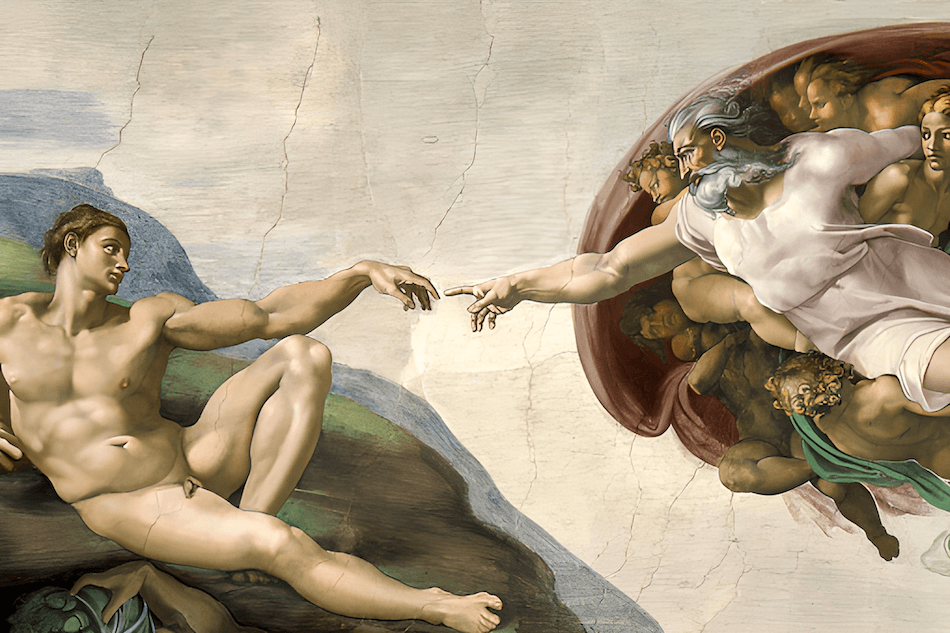
Edinger describes a third state that emerges when the ego-Self axis reaches consciousness: when the existence of the axis itself becomes known to the ego, and the ego begins, for the first time, to relate consciously to the Self rather than simply being moved by it unconsciously, or suffering the consequences of having been severed from it.
This is individuation, and let's clarify what it is and what it is not. Individuation is not enlightenment, not the resolution of conflict, and not the permanent achievement of equanimity. It is, rather, a particular quality of relationship: a sustained, conscious dialectic between two centers that remain genuinely distinct. The ego does not dissolve into the Self; the Self does not subsume or colonize the ego. What changes is the texture and depth of their relationship.
In Edinger's formulation:
"The individuation urge promotes a state in which the ego is related to the Self without being identified with it. Out of this state there emerges a more or less continuous dialogue between the conscious ego and the unconscious."
What is healed is the split between conscious and unconscious that began with the very birth of consciousness — and with it, something of the division between inner and outer, between self and world. Edinger calls this the recovery of "original unconscious wholeness," now restored at a conscious level, and held by a formed, differentiated ego rather than dissolved within an undifferentiated one.
The individuating ego has learned something the inflated ego cannot admit and the alienated ego has forgotten: that it is not the author of its own depths. That behind its decisions, its symptoms, its loves and its losses, there is a deeper directiveness at work — "an autonomous inner directiveness, separate from the ego and often antagonistic to it." This awareness is, as Edinger notes, "sometimes releasing and sometimes exceedingly burdensome."
Samuels' formulation adds necessary weight: the Self "occupies the central position of authority in relation to psychological life and, therefore, the destiny of the individual." The individuating ego begins to sense this authority, begins to distinguish between choices that arise from genuine desire and choices that arise from compulsion, between what belongs to the actual personality and what belongs to the archetype that has been living through it. As Edinger writes, drawing on the Christian theological imagery of sin, alienation, and grace:
"The ego cannot be a vessel for the influx of grace until it has been emptied of its own inflated fullness; and this emptying occurs only through the experience of alienation."
The individuation process does not announce itself. It is often presaged, Edinger observes, by "certain types of dreams, presenting the dreamer with happenings paradoxical or miraculous. Such dreams open up a transpersonal category of experience alien and strange to consciousness." They are the ego-Self axis becoming visible: the moment when something moves in the psyche that the ego did not produce and cannot account for, and the ego, rather than dismissing it, pauses to attend.
Depth analysis attempts to clarify one central theme: the psychological confronting a person now has, in some sense, always been their task, and the detours, symptoms, and seemingly arbitrary suffering were never as arbitrary as they appeared. The Self, as Samuels writes, holds the "central position of authority in relation to psychological life and, therefore, the destiny of the individual." This is not fate in a strictly deterministic sense, but something like a direction—an orientation built into the structure of the psyche itself, pressing toward its own fulfillment.
Edinger's most striking image of the ego-Self relationship may be his simplest: the ego "is, so to speak, an unconscious prefiguration of the ego." The Self came first, and it contained the ego as a possibility before the ego became a fact. The whole of psychological development is the story of that possibility coming into consciousness, coming into relation with its own source, learning, across the course of a lifetime, the difference between being the mover and being moved.
That learning is never complete. Individuation is a process, as Edinger insists, "not a realized goal; each new level of integration must submit to further transformation if development is to proceed." The ego-Self axis does not become permanently clear and stable; it must be tended, and it will be stressed, and the cycle of inflation, alienation, and restitution will repeat itself, each time, if the work is genuine, at a slightly different level, with a slightly more conscious participant.
What changes, across that spiral, is the quality of the ego's attention to what is moving within it: the capacity to pause; to take the inner life seriously as a source of meaning rather than mere interference; to inquire with honesty, which voice is speaking and from what depth; and to remain receptive to the full range of what the psyche contains, including those contents the ego would much rather not know.
That openness is the work. It begins, as most serious undertakings do, with the willingness to admit that you are not the sole author of your own being.
LP · NCPsyA · SCPsyA
Jungian psychoanalyst practicing in New York's West Village. This journal presents original essays on depth psychology, dreams, and the inner life.
These images are not mere metaphors. They are lived experiences. Analysis is how you learn to navigate them.
Schedule a free initial consultation. There is no commitment — only the opportunity to explore whether depth work is right for you.