Jungian Essays
On Saturn, the Taskmaster Archetype, and the Prison of Our Own Making
On the Saturn archetype, the inner Taskmaster who builds empires and prisons with equal precision — and the question every high-achiever must eventually face.
There is a particular kind of suffering I encounter often in my practice — one that wears the disguise of achievement so convincingly that the person experiencing it rarely recognizes it as suffering at all.
They arrive, these patients, looking exactly as one would expect a successful person to look. The posture is composed. The language is precise. They are accustomed to being competent, accustomed to being the person in the room who has the answer, who moves things forward, who gets it done. And they have gotten it done — for years, for decades, sometimes for the entirety of their adult lives.
What they say, once they begin to speak with some honesty, sounds like this:
"I look back at what I achieved and tell myself — I could have done it better."
Or: "I finally reached the goal, but once I got there, it didn't feel like much."
Or simply — there is no inner voice that ever says well done. The bar moves the moment it is cleared. The celebration never comes. The satisfaction, if it arrives at all, comes dressed as the fleeting pleasure of being seen to have succeeded — a momentary high that fades almost immediately, leaving behind only the next objective, the next benchmark, the next rung of a ladder that has no visible top.
This is not laziness. These are not people who lack ambition or discipline. Quite the opposite. They are often the most driven, most accomplished people in any room. They are the ones others point to as examples of what is possible. And yet something essential is absent — something that has nothing to do with what they have built and everything to do with how they experience what they have built.
I have come to think of this as the mechanistic success story: the capacity to produce achievement without the felt sense of achievement. To move like a well-oiled mechanism from one milestone to the next — efficiently, relentlessly — but without the interior life that would make any of it meaningful. The mechanism runs. The person inside it is no longer sure they are running it.
In Jungian psychology, the psyche thinks in images. Words come later — analysis, interpretation, narrative. But the psyche's first language is image, symbol, myth. When I sit with a patient caught in this pattern — this treadmill of achievement that never arrives anywhere — the image that rises in me is ancient. Older than psychology and analysis. Older, perhaps, than the written word.
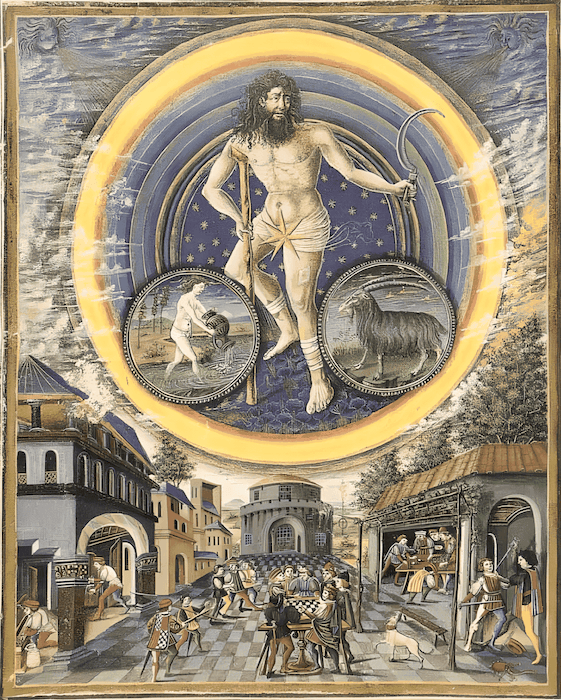
It is the image of Saturn.
Saturn — known to the Greeks as Cronos — is a complex and paradoxical figure in the mythological imagination. He is the old and crippled god, the god of time and of what time demands. He is associated with structure and discipline, with the weight of inheritance and the pressure of ancestral expectation. He rules over what must be built, maintained, and passed on. He is, in many traditions, the patron of those who labor without rest — who build what endures.
These are not small qualities. Saturn's gifts are real. The capacity to delay gratification, to work with precision over long periods of time, to hold a structure together through sheer will and discipline — these seems to beamong the most valuable things a person can possess. They are what allow a career to be built, a practice to be grown, and an institution to be maintained. Without Saturn's influence, nothing lasting gets made.
But Saturn is also, in the mythological record, a figure of extraordinary ambivalence. He is the Taskmaster who does not rest. He is the god who swallowed his own children — who consumed what he himself had created, unable to tolerate the existence of what came after him. He is the figure who rules by fear as much as by structure, who mistakes rigidity for strength and control for mastery.
And Saturn builds something else, alongside the castles and the systems and the frameworks. The same mind that constructs the grand edifice constructs the cell. Saturn presides not only over architecture but over prisons — and here I mean something very specific. Not the prisons of circumstance, of poverty or oppression or the cruelties of the external world. Those are real and deserve their own reckoning. I mean the prisons of our own psychology. The structures we build so carefully around ourselves — for safety, for efficiency, for the avoidance of uncertainty — that we can no longer distinguish the architecture from the cage.
Success, when it hardens from something fluid and alive into a rigid mechanism — when it stops being a journey and becomes a sentence — is exactly this kind of prison. The successful person continues to move, continues to achieve, continues to perform. But they are no longer the agent of their own life. They are its prisoner. And the tragedy is that the prison was built with their own hands, from the finest materials, over many years of extraordinary effort.

LP · NCPsyA · SCPsyA
Jungian psychoanalyst practicing in New York's West Village. This journal presents original essays on depth psychology, dreams, and the inner life.
.png)
To understand how this happens — how achievement becomes imprisonment — it helps to look more carefully at the archetypal figure driving it.
In Jungian psychology, an archetype is not merely a symbol or a story. It is a pattern of psychic energy — a template, as old as humanity itself, that shapes how we perceive, feel, and act in the world. We do not choose our archetypes any more than we choose the grammar of our mother tongue. They are already operating in us before we become conscious of them. What analysis offers is the possibility of meeting them consciously — of seeing which archetype is running the show, and asking whether we have chosen it or whether it has chosen us.
The Taskmaster archetype — Saturn's particular manifestation in the modern professional — operates according to a logic that is internally consistent and entirely merciless. Its premises are simple: achievement is the measure of worth. Satisfaction is premature. Rest is weakness. What has been accomplished is already in the past and therefore irrelevant. What matters is what comes next.
Under this logic, the goal is never the goal — it is merely the proof that one is capable of reaching the next goal. The promotion demonstrates that a higher promotion is possible. The company demonstrates that a larger company is possible. The book demonstrates that a better book is necessary. The Taskmaster does not celebrate. The Taskmaster does not rest. The Taskmaster does not ask whether any of this is what you actually wanted. It asks only: what is the next thing, and are you moving toward it fast enough?
I see this pattern operate most visibly at moments of transition — when a patient reaches a milestone that, by any external measure, should feel triumphant. The partnership. The exit. The award. The completion of something that took years. And instead of triumph, they feel — nothing. Or worse: a brief, hollow pleasure followed almost immediately by a creeping anxiety about what comes next. The Taskmaster has already moved the bar.
What is particularly painful about this pattern is that it masquerades so convincingly as virtue. Discipline looks like character. Relentlessness looks like commitment. The inability to rest looks like dedication. The people caught in this pattern are rarely criticized by the world — they are praised, promoted, held up as models. Which makes it exceedingly difficult to recognize that something is deeply wrong.
One of the things I have observed consistently in clinical work is that the psyche often signals its distress through the body long before it is able to articulate it in words.
The patient who has been running the mechanistic success story for fifteen years does not typically arrive saying I think I am imprisoned by my own achievement structure. They arrive saying: I cannot sleep. Or: I have been having panic attacks. Or: I went on vacation for the first time in four years, and I couldn't relax there at all.
The body is often the first honest voice in the room. It registers what the mind has been trained to override. The exhaustion that is not relieved by sleep. The anxiety that has no clear object — that floats, attaches to small things, cannot be reasoned away. The physical restlessness that makes stillness feel like death.
Jung understood that the psyche is a self-regulating system. Like any system under chronic stress, it eventually compensates — pushes back against what has been suppressed, forces into awareness what has been systematically denied. The body is one of the primary channels through which this compensation occurs. When the psyche cannot speak in words, it speaks in symptoms.
This does not mean every physical symptom has a psychological cause — that would be a dangerous oversimplification. But it does mean that when physical symptoms arrive in the context of a life that has been organized entirely around external performance and achievement, it is worth asking what the body is trying to say that the mind has not yet been willing to hear.
There is a distinction that is simple to state and surprisingly difficult to hold: it is the difference between being engaged and being driven.
Being engaged with life is a process of feeling both active and alive. It arises from desire, from curiosity, from the genuine pleasure of making something. It has an interior quality — a felt sense of engagement, of investment, of meaning. When you are genuinely doing something, you are present in it. You can feel yourself in the work.
Being driven is something else entirely. It arises not from desire but from compulsion — from the fear of what happens if you stop, from the internalized voice of the Taskmaster that says "not enough, not yet, keep going". It has a quality of an automaton — the mechanism running itself, the person inside it increasingly reduced to the role of fuel. You do not feel yourself in the work. You feel yourself consumed by it.
The distinction can be difficult to identify in the middle of a life, precisely because both look identical from the outside. The person who loves their work and the person who is compelled by it may produce exactly the same output. They may work the same hours, achieve the same results, occupy the same position. The difference is entirely interior— in the felt quality of the experience, in whether there is a self present in the activity or whether the activity has swallowed the self.
This is why the question I return to is not how much are you achieving but who is achieving? Is there a person inside the mechanism — someone who chose this, who finds meaning in it, who could in principle choose otherwise? Or has the mechanism overtaken the person?
There is an archetypal question that every successful person faces eventually — sometimes at midlife, sometimes earlier, sometimes only when the body or the psyche forces a reckoning that can no longer be postponed. It is Saturn's question — the Taskmaster's question turned back upon itself:
Do I own my success — or does my success own me?
This question can be asked in many ways. Who is driving, and who is being driven? What is the real motivation behind the next goal — genuine desire, or the compulsion to avoid the shame of not achieving? Is the goal something I am moving toward, or something I am running from?
The distinction between moving toward and running from is not always immediately visible. Both can produce motion and achievement. But they have completely different psychological structures. Moving toward has a quality of expansion and a genuine desire pulling one forward. Running from has a quality of contraction and of fear pushing one away from something that cannot be faced directly.
In my clinical experience, much of what presents as ambition is actually flight — a highly sophisticated, socially rewarded, internally exhausting form of running away. Away from the fear of inadequacy. Away from the shame of not being enough. Away from the grief of a childhood in which love was conditional on performance. Away from the question of what one actually wants, which is perhaps the most frightening question of all, because it requires an answer.
These are not comfortable questions. They are Saturn's questions. And they are worth sitting with — not because they will dismantle what you have built, but because they may reveal who built it, and why that builder will never be satisfied with anything they construct.

Jung wrote extensively about what he called the Wende des Lebens — the turning point of life, which we have come to call midlife. He observed that the values and strategies that serve a person well in the first half of life — building a career, establishing a social position, accumulating the external markers of success and security — often become inadequate and even counterproductive in the second half.
The person who organized their entire identity around external achievement arrives at midlife with a résumé that is, in some sense, complete — and finds themselves facing a void they did not expect and do not know how to name. They have climbed the mountain. They are standing at the top. And they feel — empty. Or worse: they feel that they have climbed the wrong mountain entirely.
This is not a failure of character. It is, in Jung's understanding, an invitation. The psyche is asking for something new — for a deeper engagement with the interior life, with meaning rather than achievement, with being rather than doing. The first half of life asks: What can I build? The second half asks: What is it for?
The Taskmaster archetype has no answer to that question. It can only point to the next milestone, the next benchmark, the next proof that one is still capable of achieving. Which is why, if the question is not consciously engaged, the second half of life can become a repetition of the first — but with a growing sense of futility, of motion without direction, of success that has become its own prison.
This is the reckoning that Saturn eventually demands of everyone who has lived under his rule without questioning it.
I want to be careful here not to romanticize stagnation or pathologize ambition. Saturn is not the enemy. The drive to build, to achieve, to leave something of substance in the world — these are profound human impulses, and they deserve genuine respect. Many of the greatest works of civilization have been made possible by precisely the kind of sustained, disciplined effort that Saturn makes possible.
What I am pointing to is something more subtle and more specific: the difference between a life organized entirely around achievement and a life in which achievement is one expression among many of a fuller, more integrated self. The difference between the mechanism and the person inside it. The difference between success as a means and success as a sentence.
The person who has become a mechanistic success producer has not failed. They have succeeded — extraordinarily, in many cases. But they have succeeded in a way that has cost them something they may not yet be able to name. The vitality that was present in earlier years. The curiosity that once made the work feel alive. The capacity to be moved — by beauty, by love, by grief, by the simple fact of being alive in a body. These things do not disappear. They go underground, into what Jung called the unconscious, where they wait.
The work of depth psychology is partly the work of recovering what has gone underground — of creating the conditions in which those buried parts of the self can begin to speak again. This requires, above all, a willingness to slow down enough to listen. To sit with questions that do not have immediate answers. To tolerate the discomfort of not knowing, of not performing, of simply being with what is.
This is genuinely difficult work for people who have organized their entire lives around the management of uncertainty through achievement. It requires a different kind of courage than the courage to succeed — the courage to be still. To ask the uncomfortable questions. To sit with whatever answers begin to emerge, even when those answers are not what one expected or wanted.
That is a very different kind of work. And it begins, as most important things do, with a single honest question — one that only you can answer, in the privacy of your own interior life, without the performance of an answer and without the escape of the next achievement.
Who is in the driver seat?
And what would it feel like to stop — even briefly — and find out?
LP · NCPsyA · SCPsyA
Jungian psychoanalyst practicing in New York's West Village. This journal presents original essays on depth psychology, dreams, and the inner life.
These images are not mere metaphors. They are lived experiences. Analysis is how you learn to navigate them.
Schedule a free initial consultation. There is no commitment — only the opportunity to explore whether depth work is right for you.